On this page:
Campaigns
| [Content from White Dwarf #215 page 88 to 95.] |
More ramblings by veteran campaigner and games designer Andy Chambers.
I've been working on my Epic 40,000 Ork army a lot recently, a big chunk of which was shown in WD212. What's more my long-running Warhammer 40,000 campaign, Piscina IV, has been expanded into a new and spangly Epic campaign devised by me and the eponymous Big Pete. Though I'd played Chaos in the Wamammer 40,000 campaign I swapped to an Ork army for Epic. By a bizarre twist Slim, who played Orks in the Warhammer 40,000 campaign, decided to swap to playing Chaos in Epic 40,000.
We've made the Epic campaign an expansion of the Ork invasion of Piscina IV as detailed in earlier Chambers of the Horned Rat articles and (heh, heh!) the Storm of Vengeance scenario pack. I always like to build on top of what's already been done and the campaign narrative for the Warhammer 40,000 campaign gave us a perfect springboard, all we needed was loads more forces to arrive on the planet.
Death from above
To move the story along a bit further we played a few spaceship games to represent the Ork's hulk, the Scylla attacking Piscina in order to drop and tellyport an invasion force to the surface (having failed to surprise and overwhelm the Imperial forces through use of the not-so-cunning tellyporta device).
In the main engagement the Space Marines' battle barge Unrelenting Fury survived crippling engine damage to deal a crushing blow to the Scylla, but not before it had disgorged a substantial wave of invaders. A week or two later an Imperial convoy of reinforcements fought their way through Ork attack ships in the asteroid belt to bring much-needed Titans, super heavy tanks and artillery to the defenders.
We were in business.
Where next?
After the free-form mayhem of the Warhammer 40,000 campaign we wanted to produce something which was far more structured and of a tidy, limited duration (rather than the 20+ games the Warhammer 40,000 campaign ran to). I'm going to digress badly here into a discussion on the different kinds of campaigns we considered, bear with me…
Map-based
In a map-based campaign players use a map to allocate their forces to different areas and move them around in campaign turns between battles, with the battles being fought out when opposing sides clash in the same grid location/square/hex or whatever.
Sounds great fun but generally isn't because players will consistently fail to fight out their games before the next campaign turn and forces get split up too small to make for worthwhile battles ("hah my 2,000 point army has caught your 150 point scouting force — what do you mean you won't play?").
Plus players invariably make up all sorts of rules for baggage trains or supplies and other dull stuff which really belongs in a board game and just slows down a campaign.
Map-based campaigns get Andy's award for Campaign Most Likely to Fold Before Tum Two. I've played in (and run) lots of map based campaigns but I've never finished one yet.
Story
A story campaign is one where a referee/co-ordinator type person interlinks the battles to form a continuous story. As part of this the ref can introduce specific scenarios, victory conditions, extra rules an' so on. Story campaigns are good but can start to sprawl if the co-ordinator isn't careful about setting parameters for them.
For example, the co-ordinator might decide that each time players fight, the winner takes possession of an objective like a vital location, piece of wargear or magic item and keeps it until defeated. After a preset number of games whoever's got the objective is the winner.
Ladder
In a ladder campaign the players agree to play a series of battles in a particular order (you don't really need a campaign co-ordinator for this one). Winning and losing games may introduce a special rule or forfeit into later games, ie if you lose Battle Two you can't include any elite troops in Battle Three. This is the way the Warhammer Campaign packs like Circle of Blood and Grudge of Drong work so take a look at one of these for a better idea of what I'm talking about.
Ladder Campaigns are very straight forward and win Andy's award for Campaign Most Likely to Actually Get Finished!
Tree
In a tree campaign you all play Wood Elves — no, no, I'm lying. Let's start again. In a tree campaign you have a number of battles organised a bit like a flow diagram. Each lime you fight a game whether one side wins or loses decides which way you proceed and so which battle you will fight next.
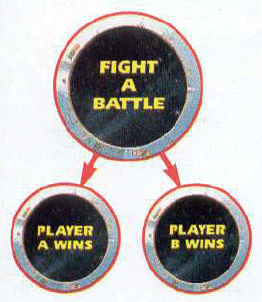
In a more extended campaign you end up with something which looks a bit like a family tree with each battle spawning a couple of others depending on the result.
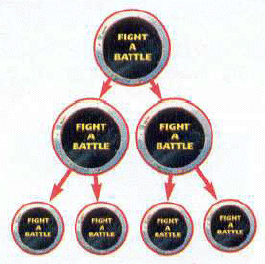
You can add in paths which loop around into sub-plots or skip parts of the tree (appropriate if one side is beating the other quite resoundingly) and so on.
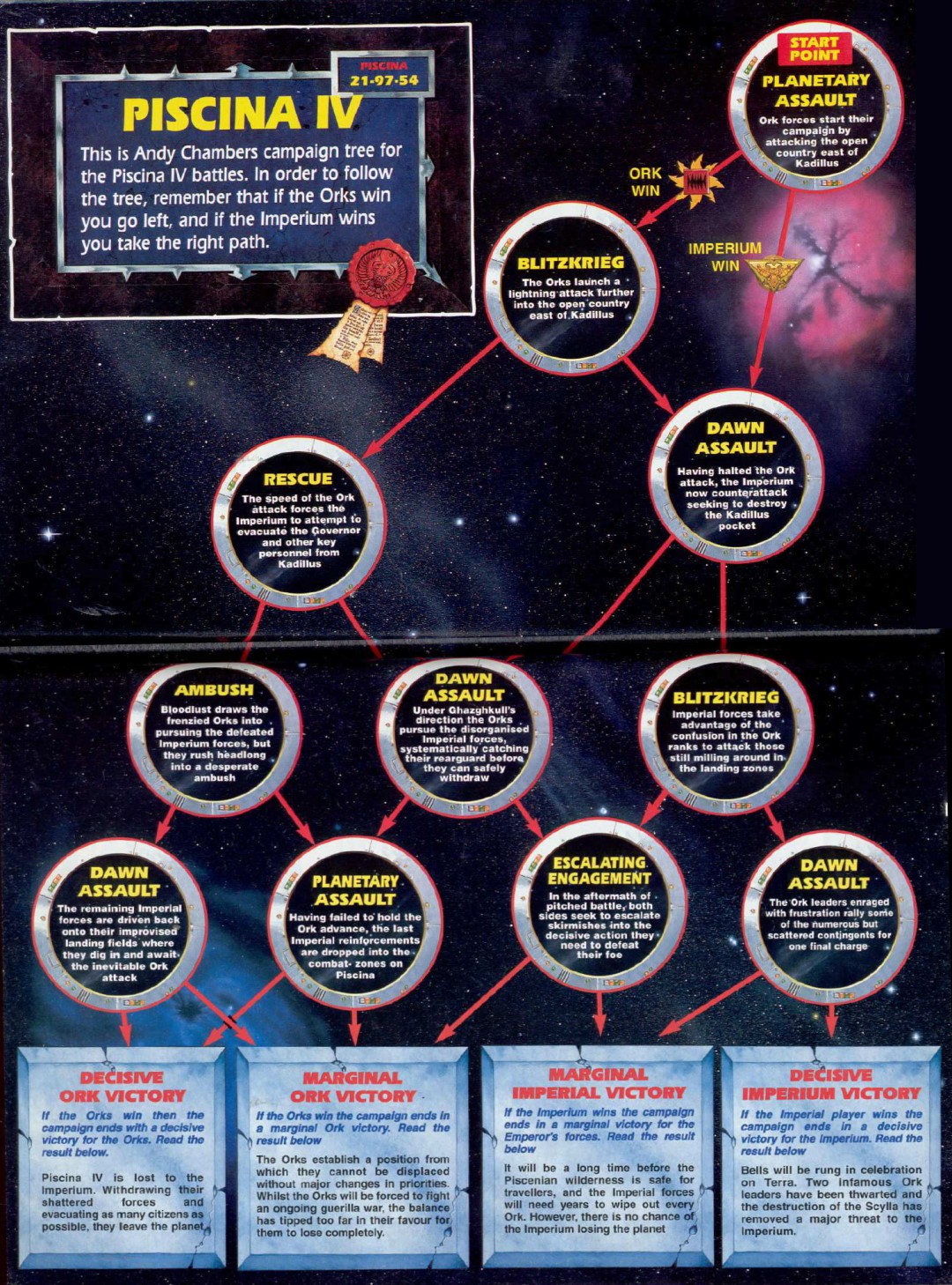
It might sound a bit complex but it's not really, ideas soon start popping out like crazy — anyway, we decided to adopt a tree approach for our campaign so I can show you a working example of it later. Tree campaigns are simple to run and offer a bit more diversity than ladder campaigns because all the battles can be different.
It's comparatively simple to create a tree for Epic 40,000 games because there are twelve scenarios listed in the Battles Book and it's simply a case of working out a narrative for the campaign to follow.
For example, when we started off ours we knew the Orks would be dropping in from space — so the first battle should be a Planetary Assault scenario. We also knew from our 40K campaign that Nazdreg and Ghazghkull were holding out against encircling lmperium forces in the planetary capital of Kadillus. So if the Orks won their planetary assault they would try to push through to Kadillus and link up with the Orks there.
We decided that this would best be represented by a Blitz scenario as the Orks would be advancing after the scattered remnants of the defenders from the planetary assault while the Imperials around Kadillus redeployed their forces to stem the tide.
If the Orks were defeated in the Planetary Assault the Imperial forces around Kadillus would be able to launch a full-blown Dawn Assault to try to eradicate the Orks there. We also decided that this would be the likely result if the Ork blitz was stopped. This gave us a start to the tree which looked like this.
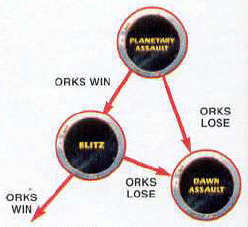
We carried on following the different paths of possibility (those Eldar Farseers are just making it up you see) until we had a tree of about the right size — which was five or six battles, This was also where the results were getting increasingly hard to extrapolate and it was plenty big enough for us!
Originally we were going to include some 40K battles at certain points of the tree, to represent Nazdreg and Ghazghkull battling to escape from Kadillus for example, but we decided we could play extra games like that when we felt like it anyway.
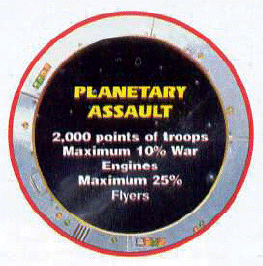
Another possibility for the tree diagram is adding extra information to scenarios like points limits, restrictions on the points available for flyers or war engines and so on.
So with a framework sorted out we were ready to start a new campaign — or were we? A campaign is a lot more than just knowing what sequence of battles to fight. It's also about developing some fighting units with a history and character of their own as they participate in major battles and come out as either conquering heroes or lilly-livered poltroons.
OK, so a campaign can also be about supply lines and carefully husbanding your resources for a decisive strike but we just assumed we had quartermasters and clerks (or the Ork equivalents) to take care of that for us. What we really wanted was a system for detachments earning experience points and getting tougher through the campaign. But more of that later!